You Won’t Believe What’s Hidden in the Amazon Rainforest
Deep in the Amazon, Brazil, nature isn’t the only wonder—there’s architecture that defies imagination. I never expected to find human-made structures blending so perfectly with the wild. From ancient earthworks to modern eco-lodges, these designs reveal how people have lived with the forest for centuries. This is discovery at its most thrilling—where every ruin, pathway, and treehouse tells a story. The Amazon is not just a landscape of trees and rivers; it is a living archive of human ingenuity shaped by necessity, tradition, and respect for nature. To walk through this region is to witness a quiet dialogue between people and planet—one that has unfolded over thousands of years, hidden beneath the canopy.
The First Glimpse: Entering a World Beyond Nature
Arriving in the Brazilian Amazon by riverboat, one is immediately enveloped by the sheer scale of the rainforest. The air is thick with moisture, alive with the calls of howler monkeys and the rustle of unseen creatures moving through the undergrowth. Towering kapok trees stretch skyward, their trunks draped in vines and bromeliads. The river itself, wide and brown, pulses with life—fishermen in narrow canoes glide past, children wave from stilted homes, and the occasional pink river dolphin breaks the surface. This is the image most travelers carry: a pristine, untamed wilderness. But as the boat rounds a bend, something unexpected appears—an angular clearing, a raised platform nestled among the trees, or a cluster of homes perched high above the water. These are not intrusions. They are part of the forest’s rhythm.
At first glance, the architectural forms seem almost alien—geometric shapes where none should exist, elevated walkways snaking through flooded areas, or thatched roofs rising above the treetops. Yet, they do not disrupt the environment. Instead, they appear to grow from it, like natural extensions of the ecosystem. The materials—wood, palm thatch, bamboo—are all drawn from the surrounding forest. The designs respond directly to the region’s challenges: seasonal flooding, high humidity, intense rainfall, and the need to coexist with wildlife. What becomes clear quickly is that these structures are not built against the jungle; they are built with it. This realization shifts the traveler’s perspective. The Amazon is not a place untouched by humans. It is a landscape shaped by generations of adaptation, innovation, and quiet resilience.
The journey deeper into the region reveals more. Small villages emerge along tributaries, accessible only by boat during certain times of the year. Children play on wooden decks while elders mend fishing nets under shaded porches. Smoke curls from clay stoves inside open-air kitchens. The architecture here is functional, beautiful in its simplicity, and deeply rooted in practical knowledge passed down for centuries. Every beam, every joint, every slope of a roof has a purpose. There is no waste, no excess. This is design born of necessity, refined over time. And it is this quiet harmony between human life and natural forces that makes the Amazon’s built environment so extraordinary.
Ancient Earthworks: The Forest’s Forgotten Blueprints
For decades, scientists believed the Amazon rainforest was too harsh and nutrient-poor to support large, organized societies. The dense vegetation, difficult terrain, and lack of visible ruins led many to assume that pre-Columbian populations were small and nomadic. That view began to change in the late 20th century when aerial surveys and satellite imagery revealed something astonishing: hundreds of geometric earthworks scattered across the southern Amazon basin. These are not natural formations. They are deliberate, human-made structures—massive circles, squares, and concentric rings carved into the earth, some over 200 meters in diameter. Known as geoglyphs, they were created between 2,000 and 800 years ago by complex societies long overlooked by history.
The discovery of these earthworks has rewritten the narrative of Amazonian civilization. Far from being sparsely populated wilderness, parts of the rainforest once hosted organized communities capable of large-scale land modification. These geoglyphs were not fortifications or agricultural fields. Their precise function remains a subject of study, but archaeologists believe they served ceremonial or communal purposes. Some are aligned with solstices or lunar cycles, suggesting an advanced understanding of astronomy. Others are connected by straight, engineered pathways, indicating planned movement and social organization. The construction required coordinated labor, sophisticated knowledge of soil management, and long-term settlement patterns—evidence of societies far more complex than previously assumed.
What makes these earthworks particularly remarkable is how they coexisted with the forest. Unlike the monumental stone architecture of the Andes or Mesoamerica, Amazonian builders worked with the land rather than against it. The geoglyphs were dug into the earth, their walls reinforced with timber and stone, but over time, the forest reclaimed them. Without modern imaging technology, they would remain invisible, hidden beneath layers of leaf litter and roots. This integration reflects a philosophy of living in balance with nature—a principle still evident in many Amazonian communities today. The geoglyphs are not ruins in the traditional sense. They are subtle imprints, quiet reminders that human presence does not have to mean domination. They challenge the myth of the Amazon as an untouched Eden and reveal a deeper truth: this forest has been shaped, nurtured, and inhabited for millennia.
Stilt Villages: Living Above the Flood
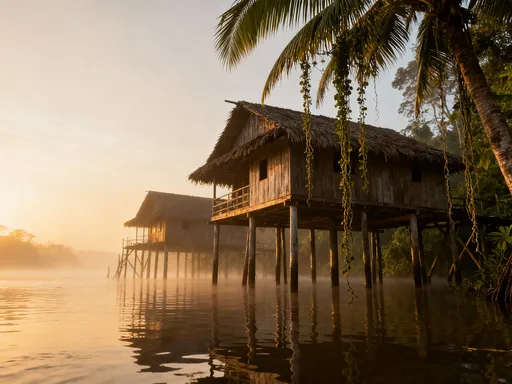
Along the winding tributaries of the Amazon River, life unfolds above the water. In regions where seasonal flooding can submerge the ground for months at a time, homes, schools, and even shops are built on wooden stilts, rising several meters above the riverbanks. These stilt villages are a testament to adaptation. When the rainy season arrives and the rivers swell, the water flows beneath the houses, leaving daily life largely undisturbed. Children still walk to school on elevated walkways, families cook and gather in open-air living spaces, and fishermen launch their boats directly from their back porches. This architectural solution is not new—it has been used for generations, refined through experience and necessity.
The construction of these homes is both practical and sustainable. Local builders use hardwoods resistant to rot and insects, often sourced from fallen trees or managed forests. The stilts are deeply anchored into the ground or secured with cross-bracing to withstand strong currents. Roofs are typically made from palm thatch, which provides excellent insulation and allows hot air to rise. The houses themselves are open on the sides, promoting natural ventilation and cooling in the humid climate. During the dry season, the space beneath the homes becomes a shaded work area—used for weaving, tool repair, or social gatherings. When the floods return, it transforms into part of the aquatic environment, blending seamlessly with the river’s rhythm.
Life in these villages is deeply connected to the river. Families rely on fishing, small-scale farming on floating gardens, and the collection of forest products like açaí and rubber. Children learn to swim before they can walk, and boats are as essential as shoes. The architecture reflects this relationship. There are no fences, no walls—only open spaces that invite community interaction and constant awareness of the natural world. Even electricity, where available, is often generated through solar panels mounted on rooftops, minimizing environmental impact. These stilt villages are not temporary shelters. They are permanent homes, carefully designed to move with the cycles of nature rather than resist them. In a world increasingly threatened by climate change and rising water levels, their wisdom is more relevant than ever.
Eco-Lodges: Modern Design in Harmony with the Wild
In recent years, a new kind of architecture has emerged in the Amazon: the eco-lodge. Designed for travelers seeking immersive, low-impact experiences, these modern retreats combine comfort with sustainability. Unlike traditional resorts, which often clear large areas of forest and rely on imported materials, eco-lodges are built to blend into their surroundings. Many are constructed on stilts or platforms, minimizing ground disturbance. They use locally sourced wood, bamboo, and thatch, and incorporate passive cooling techniques—such as high ceilings, cross-ventilation, and shaded verandas—to reduce the need for air conditioning.
Energy efficiency is a core principle. Solar panels provide electricity, rainwater harvesting systems supply water, and composting toilets eliminate the need for sewage infrastructure. Waste is carefully managed, often repurposed for gardening or biogas production. Some lodges even grow their own food in organic gardens, reducing reliance on external supply chains. These practices are not just environmentally responsible—they enhance the guest experience. Waking up in a treehouse suite to the sound of toucans and macaws, dining on fresh fish and tropical fruits in a thatched communal hall, or taking a guided walk through the forest with a local naturalist—these moments feel authentic, intimate, and deeply connected to place.
Well-known examples, such as those operating in the Mamirauá Reserve or along the Rio Negro, demonstrate how tourism can support conservation. Revenue from eco-lodges funds local employment, environmental monitoring, and community development projects. Guests are not passive observers; they are invited to learn about the ecosystem, participate in citizen science efforts, and engage with indigenous guides. The architecture itself becomes a teaching tool—every design choice reflects a commitment to sustainability. These lodges prove that comfort and ecological responsibility are not mutually exclusive. They offer a model for responsible travel: one that respects the forest, supports local people, and leaves minimal trace. In doing so, they help protect the very environment that makes them special.
Indigenous Longhouses: Communal Living at Its Finest
Among the many architectural traditions of the Amazon, the indigenous longhouse—often referred to as a maloca—stands out for its cultural and social significance. Used by various tribes, including the Yanomami, Baniwa, and Tukano, these large, communal dwellings are more than just shelters. They are centers of family life, spiritual practice, and community governance. Shaped like elongated ovals or rectangles, with steeply pitched roofs that can rise over 15 meters, malocas are designed to accommodate extended families, sometimes housing dozens of people under one roof.
The construction of a maloca is a collective effort, guided by ancestral knowledge and spiritual rituals. The frame is made from strong, flexible hardwoods, lashed together with vines. The roof is layered with palm thatch, providing excellent protection from rain and heat. The interior is open, with no internal walls, but divided into family sections along the sides. A central aisle runs the length of the structure, used for ceremonies, meetings, and daily activities. Fires are kept burning in designated areas, providing warmth and a place for cooking. The high ceiling allows smoke to rise and escape, while also creating a sense of spaciousness and connection.
What makes the maloca truly remarkable is how its design reflects social values. The lack of partitions emphasizes unity and shared responsibility. Elders occupy positions of honor near the center, and children grow up surrounded by multiple generations. The building is not owned by an individual but by the community, reinforcing collective identity. Knowledge of construction techniques is passed down orally and through practice, ensuring continuity across generations. Even the orientation of the maloca—often aligned with the sunrise or a sacred mountain—carries symbolic meaning. These homes are not static; they are rebuilt every 10 to 15 years, a process that strengthens community bonds and reaffirms cultural identity. In a rapidly changing world, the maloca remains a powerful symbol of resilience, tradition, and interdependence.
Floating Structures: When the River Is Your Foundation
In the heart of the Amazon floodplain, where water levels can rise over 10 meters during the rainy season, some communities have taken adaptation a step further: they live on floating structures. Entire homes, schools, markets, and even health clinics are built on rafts or pontoons made from recycled barrels, wooden logs, or plastic drums. These floating buildings rise and fall with the river, maintaining stability and accessibility regardless of the season. They are anchored to the riverbed with strong ropes or cables, allowing movement without drifting away. This innovative approach ensures that essential services remain available even when land is submerged for months at a time.
The engineering behind these structures is both simple and brilliant. Builders use buoyant materials that are readily available and durable. Floors are made from treated wood or composite panels, resistant to constant moisture. Roofs are lightweight and sloped to shed rain. Some floating homes include solar panels, rainwater collection systems, and onboard storage, making them largely self-sufficient. In certain areas, entire floating villages have formed, connected by narrow walkways and boat lanes. These communities maintain strong social networks, sharing resources and supporting one another through the challenges of aquatic living.
Perhaps the most inspiring examples are floating schools and health posts. In regions where children might otherwise miss months of education due to flooding, these mobile facilities ensure continuity. Teachers arrive by boat, lessons are conducted on stable platforms, and students learn in an environment that reflects their daily reality. Similarly, floating clinics bring medical care to remote populations, offering vaccinations, prenatal checkups, and basic treatments. These structures are not temporary fixes. They are permanent solutions, born from necessity and refined through experience. They demonstrate how human ingenuity can turn environmental challenges into opportunities for innovation, ensuring that life continues to thrive—even on water.
The Future of Amazonian Architecture: Sustainability as Survival
As climate change intensifies and deforestation continues to threaten the Amazon, the region’s architectural traditions offer vital lessons for the future. The challenges are real: rising temperatures, unpredictable rainfall, increased flooding, and the loss of biodiversity. Yet, the solutions already exist—in the wisdom of indigenous builders, the resilience of stilt villages, and the innovation of modern eco-lodges. The key lies in combining traditional knowledge with contemporary technology to create designs that are not only sustainable but regenerative.
Emerging projects are already doing this. Architects and communities are experimenting with bamboo-based construction, a fast-growing, renewable material that is both strong and flexible. Rainwater harvesting and solar microgrids are being integrated into village planning, reducing dependence on external resources. Digital mapping is helping to document and preserve traditional building techniques, ensuring they are not lost to time. In some areas, reforestation initiatives are being paired with sustainable housing, creating closed-loop systems where homes support the forest, and the forest supports the people.
But the future of Amazonian architecture is not just about buildings. It is about values. It is about recognizing that human survival depends on living in balance with nature, not conquering it. The structures of the Amazon—whether ancient earthworks, floating schools, or treehouse lodges—are not monuments to human dominance. They are expressions of respect, adaptability, and collaboration with the environment. They remind us that design can be both functional and humble, innovative and traditional, modern and timeless.
For travelers, researchers, and communities alike, these lessons are invaluable. They challenge the notion that progress means concrete and steel. They show that true advancement lies in listening to the land, learning from those who have lived on it for generations, and building in ways that heal rather than harm. The Amazon’s architectural wonders are not hidden because they are secret. They are hidden because we have not been looking closely enough. When we do, we find not just shelters, but stories—of survival, creativity, and harmony. And in those stories, we find a blueprint for a more sustainable world.
The Amazon’s architectural wonders aren’t just shelters—they’re testaments to resilience, creativity, and harmony with nature. From ancient patterns etched in the earth to homes that float with the floods, each structure tells a story of adaptation. Discovering them changes how we see the rainforest: not as untouched wilderness, but as a lived-in, shaped, and deeply human place. The real magic? These designs don’t conquer the jungle—they belong to it.