Why I Started Qigong Every Morning — And Why Routine Changed Everything
You’ve probably heard of qigong, but have you actually tried fitting it into your daily life? I didn’t think a 10-minute morning practice could make a difference—until I committed to consistency. Over time, the small, repeated movements and breathing patterns began to shift how I felt each day. It wasn’t about perfection, but rhythm. This is how routine turned a simple wellness habit into something truly transformative. At first, I approached it skeptically, wondering if gentle swaying and slow breathing could possibly counteract the fatigue and tension I carried from years of nonstop responsibilities. But as a woman in my late 40s balancing family, work, and personal well-being, I was running on empty. What began as a tentative experiment soon became the cornerstone of my daily health—a quiet, grounding ritual that required nothing more than my presence and a few minutes of intention.
The Burnout That Led Me to Try Qigong
For years, I considered myself health-conscious. I ate balanced meals, walked regularly, and avoided processed foods. Yet, despite all the right choices, I often felt drained by midday. My energy dipped sharply in the afternoons, my sleep was restless, and my mind felt cluttered even during moments of stillness. I wasn’t clinically unwell, but I wasn’t thriving either. It was a low-grade, persistent burnout—one that crept in slowly, fueled by years of prioritizing everyone else’s needs over my own.
The turning point came during a routine check-up. My doctor noted that while my lab results were mostly normal, my blood pressure was slightly elevated, and I admitted to frequent tension in my shoulders and neck. She didn’t prescribe medication. Instead, she asked, “When was the last time you truly rested—not just slept, but felt at ease?” That question stayed with me. I realized that while I moved my body and fed it well, I hadn’t nurtured the connection between my physical self and my inner state. Exercise was about output; rest was passive. Something was missing: a practice that invited presence, awareness, and gentle restoration.
That’s when I was introduced to qigong through a friend who studied traditional Chinese medicine (TCM). She described it not as a workout, but as a daily act of listening to the body. Unlike high-intensity routines that left me more fatigued, qigong emphasized softness, breath, and rhythm. It wasn’t about pushing limits, but about cultivating energy—what TCM calls *qi*—and allowing it to flow without blockage. Skeptical but curious, I attended my first gentle qigong class at a local wellness center. The movements were minimal: raising the arms slowly, shifting weight from foot to foot, coordinating breath with motion. I left feeling calmer than I had in weeks. It wasn’t dramatic, but it was real.
What Exactly Is Qigong? (And Why It’s Not Just “Slow Exercise”)
Qigong (pronounced “chee-gong”) is an ancient mind-body practice rooted in traditional Chinese medicine, with a history spanning thousands of years. At its core, it integrates three elements: regulated breathing, deliberate movement, and focused intention. The word itself combines *qi*, meaning vital life force or energy, and *gong*, meaning skill or cultivation. Together, qigong translates to “energy work” or “the practice of cultivating life energy.” Unlike aerobic exercise, which focuses on cardiovascular output, or yoga, which often emphasizes flexibility and strength, qigong prioritizes internal balance and nervous system regulation.
One common misconception is that qigong is simply slow exercise—like tai chi without the martial elements. While tai chi evolved from qigong and shares similar principles, qigong is more foundational and adaptable. It can be practiced standing, sitting, or even lying down, making it accessible regardless of mobility level. Yoga, though also mind-body oriented, typically follows structured postures and sequences aimed at physical alignment and breath control. Qigong, by contrast, often uses repetitive, flowing motions designed to stimulate energy channels, known as meridians, and support organ function according to TCM theory.
Modern science is beginning to validate what practitioners have known for centuries: qigong has measurable effects on the body. Studies have shown that regular practice can reduce cortisol levels, lower blood pressure, improve balance, and enhance immune function. It activates the parasympathetic nervous system—the “rest and digest” mode—helping the body recover from chronic stress. This isn’t mystical; it’s physiological. The slow, rhythmic breathing used in qigong increases heart rate variability (HRV), a key marker of resilience and cardiovascular health. Over time, these small shifts accumulate, creating a foundation for sustained well-being.
Why Quick Daily Practice Beats Occasional Long Sessions
When I first started, I assumed that to see results, I needed to practice for at least 30 minutes at a time. I tried scheduling weekend sessions, thinking I’d “catch up” on self-care. But life got in the way—kids needed help, chores piled up, or I simply felt too tired. Those long sessions became inconsistent, and my progress stalled. Then I read research on habit formation and nervous system conditioning that changed my approach: consistency, not duration, is the key driver of lasting change.
Neuroscience shows that repeated, short practices create stronger neural pathways than infrequent, longer ones. Think of it like brushing your teeth—no one expects to do it once a month and maintain oral health. The same principle applies to mental and physical regulation. A daily five- to ten-minute qigong routine signals safety to the nervous system more effectively than a single 45-minute session once a week. Over time, this regular input helps recalibrate the body’s stress response, making it easier to stay calm under pressure.
I decided to test this with a personal experiment. For one month, I practiced 30 minutes of qigong once a week. I felt good afterward, but the effects didn’t last. The next month, I committed to just five minutes every morning. By day ten, I noticed I was less reactive to small stressors—like spilled coffee or last-minute schedule changes. By week three, my morning clarity improved. The difference was undeniable: daily micro-practices built momentum. The ritual itself became a cue for my body to shift into a state of balance. Duration mattered less than frequency. This realization freed me from the pressure of “doing enough” and allowed me to embrace the practice as a sustainable part of my life.
Building a Realistic Routine: My 7-Minute Morning Flow
Creating a routine that fits real life was essential. I didn’t want to add another chore or feel guilty for skipping it. So I designed a simple, repeatable 7-minute flow that requires no equipment, special clothing, or extra time. It starts the moment I finish brushing my teeth—anchoring it to an existing habit makes it easier to remember and less likely to be skipped.
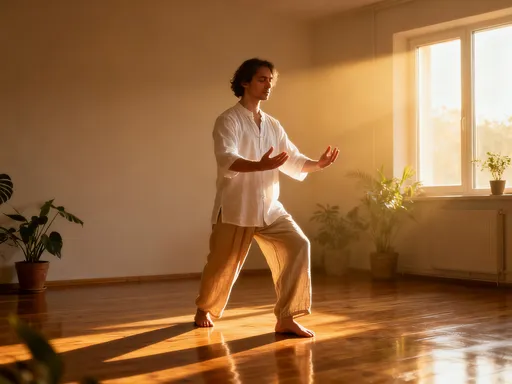
The routine begins with a standing warm-up: I stand with feet shoulder-width apart, knees slightly bent, and gently rock my weight forward and back, side to side. This loosens the joints and grounds me. Then, I bring my hands to my lower abdomen—known as the *dantian*, or energy center in TCM—and take three slow, deep breaths, inhaling through the nose and exhaling through the mouth. This signals the start of practice and shifts my focus inward.
Next, I perform three basic qigong forms. The first is “Lifting the Sky,” where I slowly raise my hands in front of me, palms up, all the way overhead, then lower them with control, imagining energy flowing down my arms. This movement stretches the meridians and promotes upward energy flow. The second is “Separating Heaven and Earth,” where one hand rises while the other sinks, alternating sides. It creates a sense of balance and alignment. The third is “Bear Swings,” a gentle torso twist that massages the internal organs and releases tension in the spine. Each form is repeated six to eight times, coordinated with the breath—inhale on the upward or opening motion, exhale on the downward or closing motion.
I use a simple timer on my phone, set to seven minutes, and practice in a quiet corner of my living room. I wear comfortable clothes—no need for special gear. The entire sequence takes less time than making breakfast, yet it sets the tone for my day. On days when I feel resistance, I remind myself: even two minutes counts. The goal isn’t perfection, but presence. Over time, this tiny ritual has become non-negotiable—like drinking water or locking the door at night.
The Surprising Benefits I Didn’t Expect
Within the first two weeks of my daily practice, I noticed subtle but significant changes. My mental fog lifted earlier in the day. I could focus on tasks without constant distraction, and my memory felt sharper. I wasn’t drinking more coffee or changing my diet—just showing up for seven minutes each morning. This improved cognitive clarity was one of the most unexpected benefits. Research supports this: qigong has been linked to enhanced attention and executive function, likely due to its effects on brainwave patterns and reduced mental noise.
Another surprise was the shift in my energy levels. I used to rely on a mid-afternoon snack or second cup of tea to push through fatigue. Now, those crashes are less frequent and less severe. I suspect this is due to better blood circulation and more stable blood sugar regulation, both supported by qigong’s gentle movements and breathwork. Additionally, my sleep improved. I fall asleep faster and wake up feeling more refreshed. The practice seems to reset my circadian rhythm, helping me wind down naturally at night.
Perhaps the most profound change has been in my emotional resilience. I still face the same daily challenges—school pickups, work deadlines, household demands—but I react to them differently. I pause before responding. I feel less overwhelmed. This isn’t because life has gotten easier, but because my internal baseline has shifted. Qigong has taught me to return to my breath, to ground myself in the present, and to respond rather than react. It’s not about eliminating stress, but about building the capacity to navigate it with greater ease.
Common Misconceptions That Almost Stopped Me
Like many people, I almost dismissed qigong before giving it a real chance. The first barrier was time. “I don’t have 30 minutes,” I told myself. But I realized that waiting for the perfect window meant never starting. Once I reframed practice as “whatever I can do today,” even two minutes became valuable. Science confirms that brief, consistent input is more effective than sporadic, longer sessions for nervous system regulation. The key is regularity, not length.
Another misconception was that qigong was “too slow” to produce real results. In a culture that values speed and intensity, slow movement can feel inefficient. But qigong works on a different level—subtle, internal shifts that accumulate over time. It’s like watering a plant every day rather than flooding it once a month. The effects aren’t always immediate, but they are lasting. I’ve learned to appreciate the quiet power of repetition and rhythm.
The third barrier was perfectionism. I worried I was “doing it wrong”—moving too stiffly, breathing at the wrong time, not feeling anything special. But qigong isn’t about technique mastery. It’s about showing up with intention. There is no single “right” way. Each person’s practice is unique. Once I released the need to perform and embraced my own rhythm, the practice became joyful, not stressful. This shift in mindset was as transformative as the physical movements themselves.
How to Start (And Stick With It) Without Overthinking
If you’re considering qigong, the best way to begin is simply—without overplanning. Start with just three to five minutes a day. Choose a quiet time, ideally in the morning, and find a comfortable space where you won’t be interrupted. You don’t need special clothes or equipment. A beginner-friendly form like “Lifting the Sky” or “Standing Like a Tree” (also known as *Zhan Zhuang*) is a great entry point. These forms are simple, require minimal coordination, and focus on breath and posture.
Look for reliable resources—online videos from certified instructors, community classes, or apps that offer guided qigong sessions. Avoid sources that make exaggerated claims or promise quick fixes. True qigong is gentle, accessible, and grounded in tradition and experience. As you begin, resist the urge to track performance. Instead, journal how you feel before and after: more calm? Less tension? Better focus? These subjective notes are more meaningful than counting repetitions or measuring duration.
Staying motivated comes down to one principle: showing up matters more than doing it perfectly. Some days you’ll feel energized; others, you’ll move slowly, barely lifting your arms. Both are valid. The habit itself is the goal. Over time, you may notice that you miss it on days you skip—proof that your body and mind have begun to rely on the rhythm. Celebrate consistency, not milestones. And remember, this is a practice for life, not a race.
Qigong didn’t change my life overnight, but my routine did. By embracing simplicity and repetition, I found a sustainable way to support my well-being. This isn’t about dramatic transformation—it’s about showing up daily for yourself, gently and consistently. If you're looking for a natural, accessible practice that fits real life, starting small with qigong might be the most powerful move you never thought to make. Always remember, though, that individual experiences vary—and consulting a healthcare provider is wise when beginning any new wellness practice.